

Konjac Noodle Manufacturer Guide for Importers: 9-Point Checklist
Oct 28, 2026 Moxiaoyu Konjac Noodles Manufacturer Certificate

A Guide for Importers and Private Label Buyers for Konjac Noodles Manufacturer
Choosing a konjac noodle manufacturer is not a purchase, it is a two-year relationship you cannot exit cheaply. Once a formula, a print cylinder and a carton die are set, switching means re-testing and re-registering, so the vetting before your first container matters more than the price on it.
This checklist is for importers, distributors and private-label owners with three or four quotes on their desk: nine checks, the document that proves each, and a scorecard for every supplier.
Key Takeaways
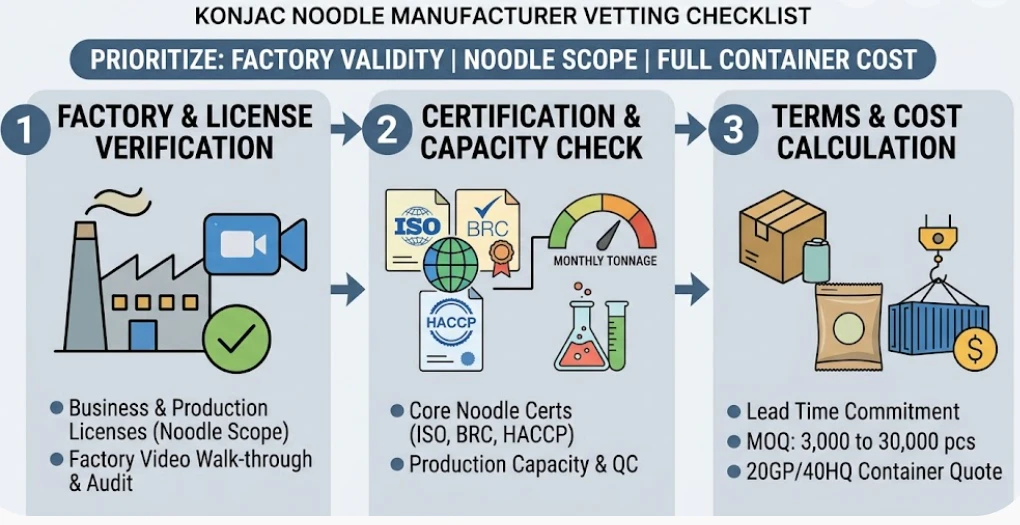
- Verify the factory before the product: business licence, production licence, video walk-through.
- A certificate only counts if its scope covers noodles, not konjac flour.
- MOQ is quoted in pieces, not kilos: 3,000 in a sticker bag, 30,000 in a printed pouch.
- Ask capacity in tonnes and lead time in days, not promises.
- Price the container, not the bag: 26,400 units in a 20GP, 52,800 in a 40HQ.
1. Decide Whether You Are Buying From a Factory or a Desk
Three documents settle it:
- a business licence whose scope includes food manufacturing
- a food production licence naming the product category
- an audit report whose site address matches.
Many desks present themselves as a konjac noodle manufacturer, which costs you control over formulation changes. If all three exist and the supplier will walk you through the line on video, you have the real thing.
Here is ours, in the same three lines. The noodles are made by Sichuan Moxiaoyu Food Co., Ltd. at No. 9, No. 376 Yongli Street, Changqing Town, Zitong County, Mianyang City, Sichuan 622150, China, under food production licence SC11251072500029. Sichuan Yijiahe International Trade Co., Ltd.is that factory's own export company, so the quote and the licence come from one group rather than a trader reselling another plant's line. Copy the format with your other candidates: legal entity, address, licence, relationship.
The Production Capacity of MoXiaoYu Factory
|
Item |
Specification |
|
Noodle lines |
6 |
|
Monthly capacity |
approx. 1,200 tonnes |
|
MOQ |
3,000 pcs (clear sticker bag) / 5,000 pcs (paper box) / 30,000 pcs (printed pouch) / 50,000 pcs (cup) |
|
Print minimum |
30,000 pcs per design |
|
Lead time |
7-10 days (bulk pack), 20-30 days (custom retail pack) |
|
Samples |
approx. 7 days |
|
Container load |
20GP = 10 pallets = 26,400 pcs; 40HQ = 20 pallets = 52,800 pcs |
|
Typical first order |
one 20GP |
|
Certifications |
BRCGS, IFS, HACCP, ISO 22000, FDA, HALAL, KOSHER, Organic |
|
ODM development |
2-3 weeks |
|
Manufacturing entity |
Sichuan Moxiaoyu Food Co., Ltd. |
|
Site address |
No. 9, No. 376 Yongli Street, Changqing Town, Zitong County, Mianyang City, Sichuan 622150, China |
|
Food production licence (SC) |
SC11251072500029 |
|
Export entity |
Sichuan Yijiahe International Trade Co., Ltd., the factory's own export company |
|
Audit access |
on-site and video, third-party accepted |
2. Start With the Flour, Not the Noodle
- Glucomannan content and viscosity
Konjac flour varies by region, harvest and refining grade, and the two specifications that predict how a noodle behaves are glucomannan content and viscosity. A supplier who cannot state both, or quotes a range too wide to enforce, is buying flour on spot price and your texture will drift.
- Lot-level certificate of analysis
Ask for three consecutive COAs from three different months; a supplier who can only produce the latest one is reconstructing documents, not keeping records. We issue one COA per lot with the shipping documents, so the lot code on the carton matches the certificate. Our panel covers pH, total plate count, coliforms, odour and foreign matter.
3. Check That the Certificate Covers What You Are Buying
Certificates have scopes, and the scope is where deals break. BRCGS and IFS are issued per site and product category; HALAL per named product, organic per SKU and per standard, so USDA NOP, EU organic, and JAS are three separate documents. The common failure is a certificate for konjac flour assumed to cover a wet retail noodle. Ask for the annex listing covered products, check the expiry, and confirm the scheme on the [BRCGS](https://www.brcgs.com/) site. Our own [certifications](/certificate) are listed with scope.
4. Match the Format to Your Channel
- Wet, dry, instant and cup formats
Wet shirataki in a pouch is the classic retail format, dry konjac cuts freight weight sharply and suits long transit lanes, and cups or soup formats serve convenience channels at higher unit cost. Our range spans wet shirataki noodles, dry shirataki noodles, instant konjac noodle soup, and organic konjac noodles, from konjac spaghetti to cup formats. If you sell in several channels, ask whether each format runs on its own line. You can also take a look at our Shirataki Noodles MOQ Guide.
- Liquid content is a cost decision
Wet noodles ship in water, and water is the most expensive thing you can ship. High liquid content inflates ocean freight and, more sharply, your local cost per unit once pallets break down. Ask for net weight against shipped weight and whether consumers must rinse, which is why konjac noodles are rinsedat all. Both move landed cost more than a cent on FOB.
5. Test MOQ Against Your First-Year Volume
MOQ is a packaging constraint, not a production one: the noodle can be made in almost any quantity, the printed film cannot.
|
Packaging format |
MOQ |
What actually sets it |
|
Clear bag with sticker label |
3,000 pcs |
Line changeover and carton count |
|
Paper box |
5,000 pcs |
Box die and print run |
|
Printed stand-up pouch |
30,000 pcs |
Printing house minimum per design |
|
Cup format |
50,000 pcs |
Cup tooling and filling line setup |
If your first order is one 20GP, a 3,000-piece sticker MOQ is roughly 11 percent of it, so we allow up to four SKUs to share that container, each at its own 3,000-piece minimum. A 30,000-piece printed MOQ exceeds a full 20GP alone, which is why a plain first run with printed film on reorder wins. Full detail is in our [shirataki noodles MOQ guide](/blog/shirataki-noodles-moq-guide.html).
6. Ask for Capacity in Tons, Not in Promises
Ask for three numbers: lines running this product, tonnage per month, and days from deposit to loading, then check them against each other. Six noodle lines at about 1,200 tonnes a month is roughly 40 tonnes a day, consistent with 7-10 days on a bulk order and 20-30 days once custom packaging enters the path.
Then ask about peak season, because the honest answer is never nothing changes. Around Labour Day in May, the summer build, the October National Day holiday and Chinese New Year, our lead times stretch a further 5-10 days as orders queue, so book those slots early.
7. Price the Container, Not the Bag
Unit price is the least useful number on a quote until you know how many units fit in a carton. Our standard pallet is 88 cartons with 30 bags per carton, which gives 26,400 units in a 20GP and 52,800 in a 40HQ.
|
Container |
Pallets |
Cartons |
Retail units |
|
20GP |
10 |
880 |
26,400 |
|
40HQ |
20 |
1760 |
52,800 |
Freight per unit falls sharply at 40HQ, so a buyer who can absorb 52,800 units of one SKU should not quote 20GP economics. And a unit price without a packing specification is not comparable, because a thinner carton moves it by several percent.
8. Confirm the Paper Trail Before You Need It
- US entry: registration, prior notice, FSVP and classification
Four things must line up: an FDA food facility registration, prior notice filed before arrival, your own Foreign Supplier Verification Program obligation as importer, and a correct tariff classification. CBP rulings NY N318612 and NY N313628 place Chinese konjac noodles in HTSUS 1901.90.9195 at 6.4 percent ad valorem plus any Section 301 duty in force; rates change, so confirm the figure with your broker. If your range includes gel cups, note FDA Import Alert 33-15, which allows detention without physical examination of mini-cup gel candies with a choking risk.
- Europe, Japan, Korea and Southeast Asia
For the EU, document allergen status, destination-language labelling and additive compliance. Japan and Korea apply tighter import notification and residue rules than most first-time buyers assume; in Southeast Asia, halal documentation is usually the gating item. Ask which markets the supplier shipped to in the last twelve months and request a redacted export document.
9. Run One Real Audit and One Real Trial Order
Ask whether the factory accepts third-party audits, on-site or by video, and how much notice it needs. A plant with nothing to hide will show you our production floor and the packing hall within a week. Then place a trial order rather than a full container: approve samples, run one pallet, and see how it behaves after transit.
The 9-Point Scorecard
Score every supplier out of 100 before you compare prices; weights reflect how much damage a failure does later.
| # | Check | Document that proves it | Pass condition | Score |
|---|---|---|---|---|
| 1 | Factory identity | Business licence + production licence | Manufacturing scope, address matches audit report | 10 |
| 2 | Raw material control | Incoming flour spec + per-lot COA | Glucomannan and viscosity stated with tolerance | 10 |
| 3 | Certification scope | Certificate annex listing products | Your exact SKU listed, unexpired | 12 |
| 4 | Format fit | Product specification sheet | Format runs on a dedicated or scheduled line | 10 |
| 5 | MOQ fit | Written MOQ by packaging type | MOQ under 20 percent of your first container | 10 |
| 6 | Capacity honesty | Lines, tonnes per month, lead time | Numbers reconcile with each other | 8 |
| 7 | Packing data | Cartons per pallet, units per carton | Container load stated in units, not kilos | 12 |
| 8 | Export documents | Registration, prior notice, FSVP support, HS code | Market-specific documents named, not generic | 14 |
| 9 | Audit and trial | Third-party audit report, trial order option | Audit accepted, trial order available | 14 |
| Total | 100 |
Five Red Flags We Have Seen Cost Buyers Money
- MOQ is quoted only in kilos. That hides the constraint that will stop your order.
- Lead time ignores the printer. Twenty days of noodle plus thirty days of film is fifty days.
- No COA per lot. A supplier who does not keep them will not start keeping them for you.
- The factory cannot be seen: no video, no dated photos, no address on a map.
A Case: What Changed When a French Buyer Switched
A distributor in France was already buying konjac noodles and konjac rice from China, and the complaint was not quality, it was freight: high-liquid packs meant paying to ship water on two legs, ocean and last mile, and consumers had to rinse before cooking. We moved them to a low-liquid format, so freight and last-mile cost per unit fell and the product became ready to use. That account went from two pallets a month to two containers a month.
How We Work With Importers: The 4-Step Process
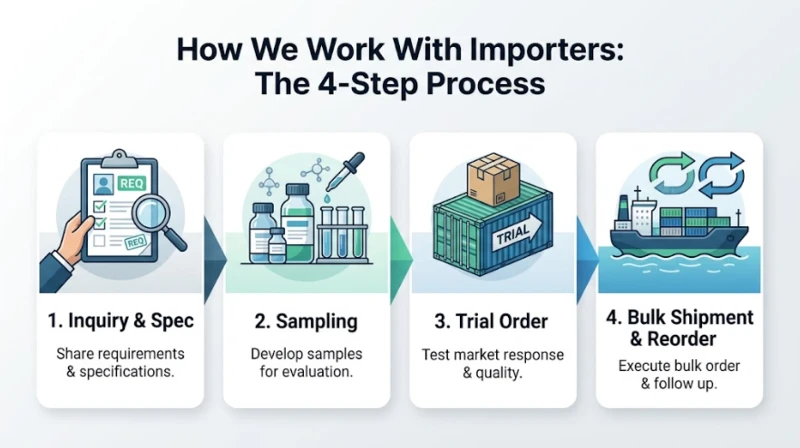
Step 1 - Inquiry and specification
Send target format, pack size, market, and annual volume. We'll confirm feasibility, note labelling gaps, and quote MOQ by packaging type.
Step 2 - Sampling
Samples ship in about 7 days; a new ODM formula takes 2-3 weeks. Spec sheet and COA travel with them, so your QA team can test rather than taste.
Step 3 - Trial order
Most buyers start with one 20GP, or 26,400 retail units at our standard packing: enough for a real market test, small enough that a formulation change stays cheap.
Step 4 - Bulk shipment and reorder
Lead time is 7-10 days for bulk packs and 20-30 days for custom retail packaging. Packing specifications are kept on file for identical reorders.
FAQ
Q: How can I tell whether a konjac noodle manufacturer is a real factory or a trading company?
A: Ask for three documents and check that they agree with each other: a business licence whose registered scope covers food manufacturing, a food production licence naming the product category, and a third-party audit report whose site address matches the licence address. A genuine factory will also walk you through the line on video.
Q: What certifications should a konjac noodle manufacturer hold?
A: For most export markets the working baseline is HACCP and ISO 22000, with BRCGS or IFS expected by mainstream retail, FDA facility registration required for the United States, and HALAL or KOSHER where your market asks. Always read the annex: a flour certificate does not cover a finished noodle.
Q: What is a reasonable MOQ for a first konjac noodle order?
A: It depends almost entirely on packaging rather than production: a clear bag with a sticker label usually starts near 3,000 pieces, a paper box near 5,000, and a printed stand-up pouch near 30,000 because the printing house sets that floor. A sensible first order stays under one container, and we let up to four SKUs share it.
Q: How long does it take to produce and ship a konjac noodle order?
A: On bulk packaging expect roughly 7 to 10 days from deposit to loading, and 20 to 30 days once custom retail film enters the schedule, because the printer rather than the noodle line sets the critical path, and that gap surprises most first-time buyers.
Q: How many konjac noodle units fit in a 20GP container?
A: At 88 cartons per pallet and 30 bags per carton, a 20GP holding 10 pallets carries 26,400 retail units, and a 40HQ holding 20 pallets carries 52,800 of the same unit, so freight per unit falls sharply once you can fill the larger container. Always request cartons per pallet and units per carton.
Q: Do konjac noodle manufacturers accept third-party factory audits?
A: Reputable manufacturers do accept them, and a good answer is specific about format and notice period, covering on-site visits and live video audits by your team or a third-party firm such as SGS, Intertek, TUV or Bureau Veritas. A supplier who refuses visual access is telling you something.
Q: What documents does a konjac noodle manufacturer need to provide for US import?
A: Expect to assemble four items: the manufacturer's FDA food facility registration, prior notice filed before the shipment arrives, documentation supporting your own Foreign Supplier Verification Program duties as importer, and a correct tariff classification for the finished noodle rather than the raw flour. CBP rulings NY N318612 and NY N313628 place Chinese konjac noodles in HTSUS 1901.90.9195 at 6.4 percent plus any Section 301 duty in force.
Q: Can a konjac noodle manufacturer produce private label or ODM products?
A: Yes, but the two are different commitments: private label puts your artwork on an existing formula and pack and moves quickly, while ODM develops a new formula, shape or flavour before any sampling can begin, which adds two to three weeks. Confirm which one your supplier is quoting.

Talk to Our Export Team
If you are comparing konjac noodle manufacturers right now, send us the scorecard with your answers and we will tell you where we score. Send your specifications for a quote with MOQ by packaging type, or request free samples and test us against the rest of your list. Our company background is public for the same reason.